Largest U.S. Crypto Media Brands Miss Top 10 for Q4 Growth, Outset Data Pulse Shows
As the U.S. crypto mediascape moves into 2026, the Q4 2025 data from Outset PR reveals an unexpected turn in the competitive dynamics. The latest Outset Data Pulse report says that despite their market dominance, none of the largest American crypto media made it into the top 10 for growth during a quarter when the broader market was contracting.
The backdrop to all of this was a sharp traffic pullback, with U.S. crypto-native outlets dropping from roughly 148 million visits in Q3 to about 106 million in Q4, down 28%.
Not even the major players like CoinDesk were immune and their growth slowed, too. They’re still the biggest names by far, but in late 2025, even they weren’t really growing the way they used to.
“Honestly, it felt like a quarter where the market stopped rewarding familiarity,” said Maximilian Fondé, senior media analyst at Outset PR. “During Q4, Americans were looking for something useful, fast, and specific instead of clicking out of habit. Some smaller websites delivered that better than the giants.”
Outset PR’s top 10 media list is based on its proprietary Composite Score metric that combines quarterly growth performance and user engagement quality, highlighting which publishers gained traction even as the overall market pulled back.
In the USA, smaller, mid-tier outlets had an edge that allowed them to grow by 10-70% when larger competitors stalled. They stayed focused by serving specific niches and giving readers exactly what they came for.
Some publishers leaned hard into fast-moving headlines and real-time sharing (especially on X) which helped them catch the attention of readers who want market updates the moment they happen. Others seemed to win by keeping people around longer, with content that encourages readers to click through more than one page. A few outlets played a different game entirely: their strength came from practical, repeat-use pages like forecasts, chart history, and reference-style tools that people come back to when they need a quick answer.
The issue for big media brands is simple: when you already dominate the market, it’s harder to get the same percentage of growth compared to smaller, more nimble competitors. Many of these heavyweights struggled to retain their audience during a period when Bitcoin’s volatility cooled and speculative interest began to fade. With less drama in the market, the high-profile outlets that rely on mass attention struggled to keep readers checking in.
Outset PR’s tier breakdown shows just how steep the imbalance remains: tier-1 publishers still captured more than 95% of all crypto-native traffic in Q4, while everyone else was left with a thin slice.
AI Is Growing, X Still Rules and Both Shape Who Gets Seen
Even as overall traffic drops, discovery is just getting rerouted. Some of it is now flowing through AI tools, and most of what’s left on social media is still flowing through X. At the same time, direct traffic stayed unusually strong and made up about 44% of all visits in Q4, which came as a sign that the most resilient outlets still have readers coming back intentionally.
According to Outset Data Pulse, AI referrals now account for almost 26% of total referral traffic across U.S. crypto media outlets. Websites like DrooomDroom, for instance, pulled nearly 90% of its traffic from AI-driven referrals. That’s the kind of presence media get when their content is built to be easily picked up, quoted, and surfaced in automated answers.
But there’s a tradeoff. The same publishers benefiting from AI visibility are also exposed to it. If the systems change what they prioritize, that traffic can disappear just as quickly as it arrived.
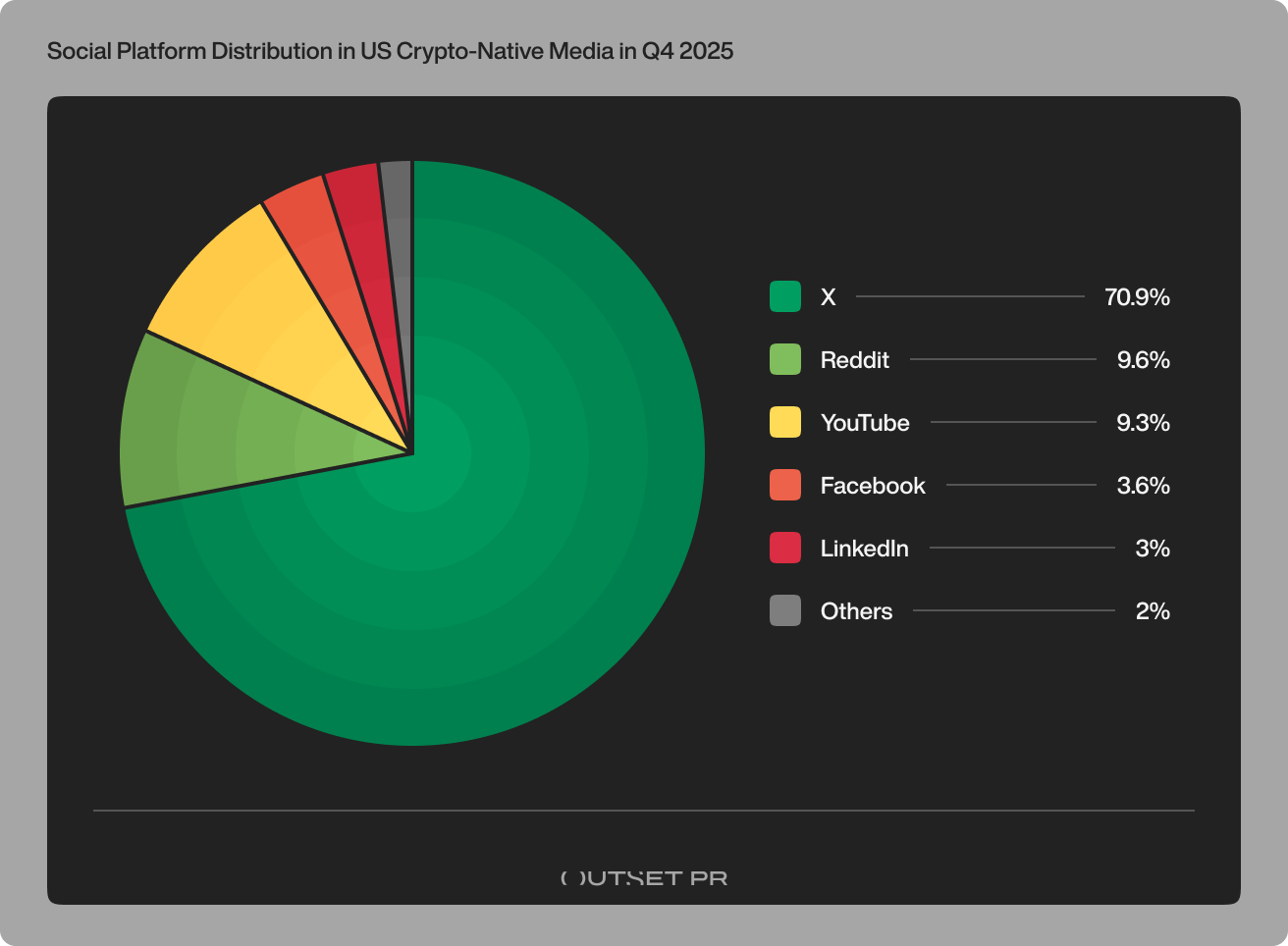
That kind of dependency isn’t new in crypto media either. On social media, the ecosystem has already narrowed down to a single dominant platform. X drove close to 71% of all social traffic, which translates to over 6 million visits.
Source: Outset PR
Reddit came next with about 9.6% of social traffic, drawing readers into slower, more discussion-driven coverage. YouTube was close behind at 9.3%, bringing in audiences who stick around longer for deeper, long-form analysis. Compared to crypto-native outlets, mainstream financial websites saw a much smaller decline of around 14%, which only proves how uniquely tied crypto media remains to market attention cycles.
The Next Winners Won’t Be the Loudest Names
In a quarter where overall traffic was falling, the outlets that managed to grow weren’t the ones with the loudest brand names. They were the ones that gave readers something concrete: faster updates, more utility, or content that fit the way discovery works now.
As Fondé put it, “Q4 wasn’t a quarter where the giants collapsed. It was a quarter where smaller outlets proved they could still move faster.”
That’s what makes this shift worth watching going into 2026. Crypto media is still concentrated at the top, but growth is no longer guaranteed to stay there. The next breakout names won’t necessarily come from who already owns the most traffic, but from who understands where attention is actually flowing: through repeat readers, through automated discovery, and through the few platforms that still drive real distribution. The hierarchy is still intact. But the momentum is starting to travel.